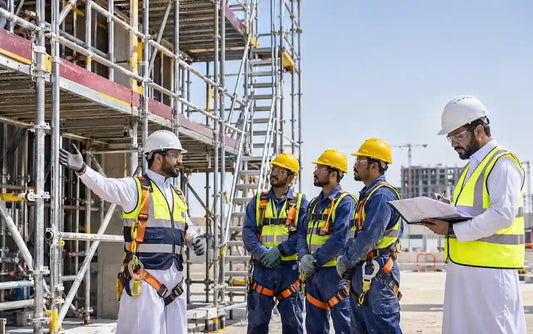
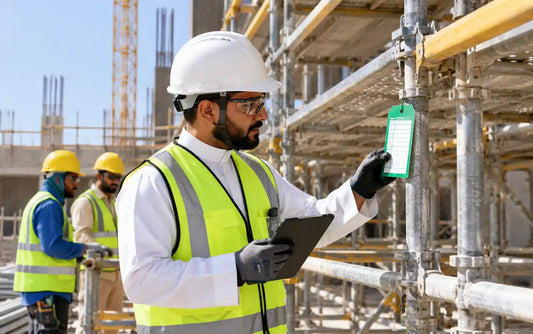
On a Saudi construction or industrial site, three job titles are often confused: the scaffolding foreman, the scaffolding supervisor and the safety manager. All three are responsible for keeping people safe at height, but they work at different levels. The foreman leads the scaffolding crew on the ground, the supervisor answers for the safe erection, alteration and dismantling of each scaffold, and the safety manager owns the safety system for the whole project or company.
This guide explains what each role does, how they differ, which Saudi rules shape them in 2026, and how professionals move from one to the next.
- Scaffolding foreman: leads the scaffolding crew day to day and makes sure the work is done to the approved plan.
- Scaffolding supervisor: responsible for safe erection, alteration and dismantling, inspections and scaffold tags.
- Safety manager: sets safety policy, risk assessment, permits, training and compliance across all sites.
- Since July 2026, scaffolders in Saudi Arabia fall under the Regulation on the Organization of Work in High-Risk Occupations.
The Five Roles in a Scaffolding Team
Titles vary from one employer to another, but most Saudi scaffolding teams follow the same ladder:
| Role | Main focus | Typical authority | Usually reports to |
|---|---|---|---|
| Scaffolder (erector) | Building, altering and dismantling scaffolds | Follows the method statement and the foreman's instructions | Scaffolding foreman |
| Scaffolding foreman | Leading the crew on site | Allocates tasks, checks workmanship, stops unsafe work | Scaffolding supervisor |
| Scaffolding supervisor | Safe erection, alteration and dismantling of every scaffold | Approves scaffolds for use, carries out inspections, controls tags | Construction manager or project manager |
| Scaffold inspector | Independent verification of scaffold safety | Co-signs or rejects inspection tags | Safety department or client |
| Safety manager (HSE manager) | The safety system for the whole project or company | Sets policy, approves permits and risk assessments, can stop any work | Project director or senior management |

What Is a Scaffolding Foreman?
A scaffolding foreman is the working leader of a scaffolding crew. They are usually an experienced scaffolder who has moved up to run a team, and they spend most of the day at the scaffold rather than in the site office. A typical foreman:
- Briefs the crew each morning on the day's scaffolds, hazards and method statement.
- Allocates scaffolders to tasks and checks that materials, tools and fall protection are ready.
- Checks workmanship as the scaffold goes up — base plates, ties, bracing, boards and guardrails.
- Stops work when conditions change, such as high wind or an unsafe access route, and escalates to the supervisor.
The foreman's authority is practical and immediate: they make sure the crew builds exactly what was planned. They do not normally approve a scaffold for use by other trades — that decision sits with the supervisor or inspector.
What Does a Scaffolding Supervisor Do?
The scaffolding supervisor carries formal responsibility for each scaffold being safe. Saudi Aramco's General Instruction GI 8.001, Safety Requirements for Scaffolds, defines the scaffold supervisor as a full-time employee of the scaffold erector who is the immediate supervisor of the craftsmen, and makes them responsible for erection, alteration and dismantling being carried out safely and according to the accepted plan. The same instruction requires scaffolds to be re-inspected at least every two weeks and uses a tag system:
- Green tag: the scaffold is complete, inspected and safe for use.
- Yellow tag: use is restricted to workers wearing a properly anchored personal fall arrest system.
- Red tag: the scaffold has not been inspected or is not safe for use.
- Re-inspection: a green or yellow tag is valid for a maximum of two weeks.
On Aramco projects, an independent scaffold inspector also co-signs the tags for special scaffolds and scaffolds over 6 metres. Our Aramco scaffold inspection checklist walks through what is checked at each inspection, and the full list of daily duties is covered in our guide to scaffolding supervisor roles and site responsibilities.
International standards draw the same line between building a scaffold and approving it. Under the US regulation OSHA 29 CFR 1926.451, scaffolds must be inspected by a competent person before each work shift and may only be erected, moved, dismantled or altered under the supervision of a competent person. In the UK, the HSE's tower scaffold guidance requires inspection by a competent person after assembly and then every seven days. Saudi clients and contractors often reference these benchmarks alongside their own procedures.
What Does a Scaffolding Safety Manager Do?
Note that a scaffolding supervisor is not the same as a general safety (HSE) supervisor: the scaffolding supervisor answers for scaffolds built by their own crew, while an HSE supervisor or officer monitors all hazards on site for the safety department.
The safety manager — often titled HSE manager on Saudi projects — does not usually supervise a single scaffold. Their job is to make sure the whole system works, across every trade and every site:
- Writing the scaffolding and work-at-height procedures, and approving risk assessments and method statements.
- Running the permit-to-work system and confirming that only qualified, fit workers are assigned to high-risk tasks.
- Auditing contractors, investigating incidents and near misses, and tracking corrective actions.
- Planning training, reporting safety performance to senior management, and keeping the company aligned with Saudi regulations and client standards such as the scaffolding safety standards every supervisor must know.
The safety manager has the authority to stop any work on site — including work the supervisor has approved — if it is not safe.
Who Does What: Responsibility Matrix

| Task | Foreman | Supervisor | Safety manager |
|---|---|---|---|
| Daily crew briefing | Leads | Supports | Sets the standard |
| Erecting to the approved plan | Leads | Accountable | Audits |
| Inspection and tagging | Supports | Leads | Audits |
| Risk assessment and method statement | Contributes | Prepares | Approves |
| Permit to work for work at height | Follows | Requests | Approves |
| Incident investigation | Contributes | Contributes | Leads |
The Saudi Rules That Shape These Roles in 2026
The biggest change for scaffolding teams is the Regulation on the Organization of Work in High-Risk Occupations, published in the Umm Al-Qura official gazette on 9 January 2026 and in force 180 days later, in July 2026. The official regulation text published by the National Council for Occupational Safety and Health lists "Scaffolding Installer" (occupation code 711901) among the high-risk occupations and treats working at heights as a specific hazard. For each role, this means:
- Scaffolders must obtain the required training, qualifications and licences before starting work, and pass pre-employment and periodic occupational fitness examinations.
- Foremen and supervisors must have the occupational safety and health knowledge and skills that match the hazards of the work they lead (Article 13).
- Employers and safety managers must not assign anyone to high-risk tasks without a valid permit, or with an expired permit or failed medical tests, and must follow up on contractors' compliance (Article 5).
- Everyone must use the required protective equipment and report unsafe practices.
The safety profession itself is also being professionalised: the Saudi Press Agency reported a licensing and classification framework for occupational safety and health practitioners, with separate professional and practitioner tracks. Our guide to the high-risk occupation work permit in Saudi Arabia explains the permit process step by step.
Career Path: From Scaffolder to Safety Manager
Most scaffolding leaders in Saudi Arabia move up the same ladder:
- Scaffolder — learns erection, alteration and dismantling under supervision and obtains the required occupational licence.
- Scaffolding foreman — leads a crew after several years on site, with strong knowledge of scaffold systems and method statements.
- Scaffolding supervisor — takes formal responsibility for inspections and tags; some clients, such as Saudi Aramco, set their own training and competence requirements for scaffold supervisors and inspectors.
- Scaffold inspector — provides independent verification, often for the client or a third party.
- HSE officer — broadens from scaffolding into all site hazards, permits and audits.
- Safety manager — leads the safety system for a project or company, usually after formal occupational safety qualifications.
The step from foreman to supervisor is where structured learning matters most, because the role moves from building scaffolds to judging whether they are safe. Our guide on how to become a scaffolding supervisor in Saudi Arabia covers that step in detail.
Training for Each Role
Training expectations rise with each step up the ladder. The US standard OSHA 29 CFR 1926.454 is a useful reference: everyone who works on a scaffold must be trained by a qualified person to recognise its hazards, and anyone who erects, dismantles, moves, repairs or inspects a scaffold must be trained by a competent person.
For foremen, supervisors and HSE staff who want a structured overview of the supervisor's role, the online Certified Scaffolding Supervisor Course (Saudi Arabia), available in Arabic and English, covers scaffold design and load management, supervising safe erection, modification and dismantling, inspection and risk assessment, and leadership and safety culture. It leads to a digital certificate of completion; it is not a CISRS card, a Saudi Aramco approval or a government licence, so check what your client or employer requires on top of it.
Conclusion
The foreman, the supervisor and the safety manager all protect people working at height, but at different levels: the foreman leads the crew, the supervisor answers for each scaffold, and the safety manager owns the system. With scaffolders now classed as a high-risk occupation in Saudi Arabia, clear roles, valid permits and the right training at each step matter more than ever.