A workplace incident rarely begins with one dramatic failure. More often, it starts with a small hazard that everyone saw, but no one assessed properly.
That is why Modern Risk Assessment KSA has become a serious priority for employers in 2026. Saudi workplaces are changing fast. Construction sites, factories, warehouses, hospitals, offices, logistics hubs, energy facilities, and corporate teams now face a mix of physical, behavioural, digital, and operational risks.
Saudi Arabia’s safety environment is also becoming more structured. The National Council for Occupational Safety and Health provides a national platform for occupational safety and health development, while Saudi safety policy is connected to broader Vision 2030 transformation goals.
Disclaimer: This guide is for educational purposes only. It does not replace legal, safety, engineering, medical, or regulatory advice. Employers should verify current requirements with official Saudi authorities and qualified HSE professionals.
The 2026 Safety Shift: Moving Beyond Traditional Risk Checklists
 Modern Risk Assessment KSA is no longer about filling out a form once a year. Traditional checklists still help, but they cannot manage the complexity of modern work environments on their own.
A checklist may confirm that PPE exists. A modern risk assessment asks deeper questions: Are workers using it correctly? Are supervisors checking it? Are near-misses reported? Are repeated findings showing a bigger system problem?
Saudi Arabia’s National Policy on Occupational Safety and Health connects occupational safety and health development with national objectives, including stronger OSH practices and performance monitoring. This makes risk assessment a performance tool, not just a compliance document.
Quick fact: A checklist shows whether a control exists. A modern risk assessment shows whether the control works.
For Saudi employers, the direction is clear. Safety must move from paperwork to prediction. That means stronger hazard identification, better reporting, digital evidence, and faster corrective action.
Identifying Modern Hazards: From Physical Risks to Digital Fatigue
A strong Modern Risk Assessment KSA approach starts with a wider view of hazards.
Most organisations already understand traditional risks such as falls, machinery, chemicals, lifting, fire, electrical exposure, heat stress, and moving vehicles. These risks still matter. But modern work adds new hazards that may be missed by older templates.
These include digital fatigue, long screen exposure, remote work ergonomics, mental stress, shift fatigue, mobile-device distraction, weak contractor supervision, cyber-physical system failures, and risks created by automation or sensors.
The Ministry of Human Resources and Social Development provides health and safety guidance explaining that employers must take necessary precautions to protect workers from hazards, occupational diseases, machinery risks, and unsafe work conditions.
Example: A warehouse may control forklift routes but ignore fatigue from long shifts and handheld scanner use. A corporate office may provide ergonomic chairs but fail to manage prolonged screen exposure. A factory may install alarms but not train workers on how to respond when alarms activate.
Modern hazard identification should cover the full work system: people, processes, equipment, environment, technology, contractors, and behaviour.
The Five Steps of Modern Risk Assessment in the Saudi Context
 To answer “how to conduct a modern risk assessment in Saudi Arabia,” employers need a simple but disciplined process. A Digital HSE framework can improve tracking, but the core method remains practical.
Step 1: Identify hazards
Walk the workplace. Review incidents, near-misses, maintenance logs, complaints, and inspection findings. Talk to workers. Check equipment, chemicals, layout, lighting, weather exposure, shift patterns, contractor activity, and digital systems.
Step 2: Identify who may be harmed
Do not focus only on direct employees. Include contractors, visitors, delivery drivers, patients, customers, cleaners, maintenance workers, temporary staff, and remote workers.
Step 3: Evaluate risk level
Assess both likelihood and severity. A rare hazard with fatal consequences may require urgent action. A common minor injury trend may reveal process weakness.
Step 4: Select controls
Use the hierarchy of control: eliminate, substitute, engineer, administer, and then use PPE. PPE is important, but it should not be the first or only answer.
Step 5: Review and improve
Update the assessment after incidents, process changes, new equipment, new chemicals, new locations, or repeated near-misses.
Practical example: If workers keep slipping near a loading bay, do not only remind them to “be careful.” Review drainage, floor surface, lighting, footwear, cleaning schedules, traffic flow, signage, and supervision.
Leveraging Technology: AI and IoT in KSA Workplace Safety
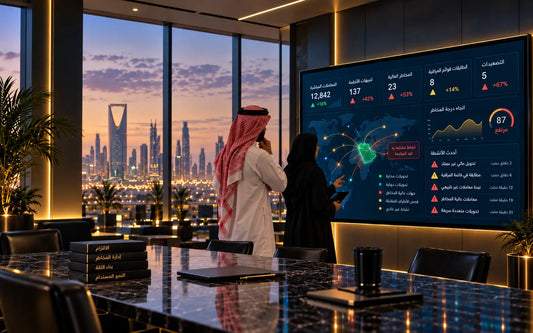
Modern Risk Assessment KSA is becoming more data-driven. AI, IoT sensors, wearables, mobile inspection apps, digital permits, and dashboards can help safety teams see risk earlier.
In industrial workplaces, IoT sensors can monitor gas, temperature, vibration, air quality, machine condition, or heat exposure. Wearables may help detect fatigue indicators, unsafe proximity to equipment, or environmental stress. AI can support predictive risk modeling by identifying patterns in incident reports, near-misses, shift schedules, maintenance records, and inspection trends.
Technology does not replace HSE judgement. It improves visibility.
Traditional vs Digital Risk Assessment
|
Area |
Traditional Approach |
Modern Digital Approach |
|
Inspections |
Paper forms |
Mobile inspection apps |
|
Incident trends |
Manual review |
Dashboards and analytics |
|
Equipment risk |
Periodic checks |
Sensor-based monitoring |
|
Corrective action |
Email follow-up |
Tracked workflow |
|
Risk prediction |
Supervisor judgement |
Data-supported modeling |
Key idea: Data does not make a workplace safe by itself. People still need to act on the signals.
NCOSH and Saudi Labor Law: Ensuring Legal Compliance in 2026
 Occupational health and safety KSA compliance must align with Saudi legal and regulatory direction. NCOSH is an important official reference point for safety officers and employers reviewing current occupational safety and health resources.
The NCOSH rules and regulations page is especially useful for reviewing Saudi OSH materials and updates. It was last modified in April 2026, making it relevant for teams updating their 2026 safety documentation.
Employers should also monitor requirements for high-risk work. The Regulation on High-Risk Occupations states that workers, employees, and supervisors involved in high-risk occupations and tasks must have the necessary cognitive and skill-based competencies in occupational safety and health.
This matters for sectors such as construction, logistics, manufacturing, energy, warehousing, maintenance, industrial services, and any work involving hazardous tasks.
For organisations building internal capability, Risk assessment and hazard control in the modern work environment can help managers and HSE teams connect hazard identification with practical control planning.
Cultural Transformation: Building a “Safety First” Mindset in Teams
A Modern Risk Assessment KSA programme will fail if workers see safety as paperwork. Culture decides whether people report hazards, challenge unsafe behaviour, and follow controls when no one is watching.
A safety-first mindset depends on three behaviours: leaders listen, supervisors act, and workers speak up.
Managers should avoid blaming workers too quickly. If someone bypasses a control, ask why. Was the right tool unavailable? Was the process too slow? Was training weak? Was production pressure too high?
Safety Culture vs Compliance Culture
|
Compliance Culture |
Safety-First Culture |
|
“Complete the form” |
“Understand the risk” |
|
Blame after incidents |
Learn before recurrence |
|
PPE as the main answer |
Hierarchy of controls |
|
Workers stay silent |
Workers report hazards |
|
Safety is HSE’s job |
Safety is everyone’s job |
Example: A worker reports a damaged ladder. In a weak culture, the report is ignored until someone falls. In a strong culture, the ladder is removed, replaced, logged, and the inspection process is reviewed.
Audit Readiness: A 2026 Checklist for Saudi Safety Officers
 For Saudi safety officers, audit readiness means proving that risk assessments are current, controls are active, and corrective actions are closed.
Use this 2026 checklist:
|
Area |
Audit Question |
|
Hazard register |
Are major workplace hazards identified and updated? |
|
Risk scoring |
Are likelihood and severity ratings documented? |
|
Controls |
Are controls selected using the hierarchy of control? |
|
Training |
Are workers trained on hazards and controls? |
|
Legal compliance |
Are NCOSH and MHRSD safety references reviewed? |
|
Incident data |
Are near-misses and incidents analysed for trends? |
|
Digital tools |
Are inspections and actions tracked digitally where possible? |
|
Contractors |
Are contractor risks included in assessments? |
|
Corrective actions |
Are actions assigned, tracked, and closed? |
|
Review cycle |
Are assessments updated after changes or incidents? |
A useful safety audit should not only ask whether documents exist. It should test whether controls work. Interview workers. Observe the site. Check logs. Review repeated findings. Compare risk assessments with real conditions.
Conclusion
Modern Risk Assessment KSA is becoming more technical, more digital, and more important to business performance. Saudi employers need more than traditional forms. They need a risk assessment system that identifies physical, behavioural, digital, and operational hazards before they become incidents.
A strong approach combines legal awareness, NCOSH-aligned resources, Saudi labor safety duties, digital HSE tools, predictive risk modeling, and a culture where workers feel responsible for safety.
For teams ready to upgrade their safety practice, Risk assessment and hazard control in the modern work environment can support supervisors, HSE officers, and managers who need practical control skills for the modern workplace.
FAQs
What is Modern Risk Assessment KSA?
Modern Risk Assessment KSA is a structured approach to identifying, evaluating, controlling, and reviewing workplace risks in Saudi Arabia using current legal expectations, digital tools, worker input, and practical control methods.
How do you conduct a modern risk assessment in Saudi Arabia?
Start by identifying hazards, deciding who may be harmed, scoring likelihood and severity, selecting controls using the hierarchy of control, and reviewing the assessment after changes, incidents, or new risks.
What is a Digital HSE framework?
A Digital HSE framework uses tools such as mobile inspections, dashboards, IoT sensors, incident analytics, and automated corrective actions to improve visibility and control of workplace risks.
How is AI used in workplace safety in KSA?
AI can support workplace safety by analysing incident trends, near-misses, equipment data, fatigue indicators, and environmental readings to predict where future risks may appear.
What official bodies are relevant to occupational health and safety in Saudi Arabia?
Key references include NCOSH for occupational safety and health development and MHRSD for labor-related workplace health and safety duties. Employers should monitor official updates and sector-specific requirements.
What should a Saudi safety audit checklist include?
A Saudi safety audit checklist should include hazard registers, risk scoring, control effectiveness, worker training, contractor risk, incident trends, corrective actions, legal compliance, and review frequency.