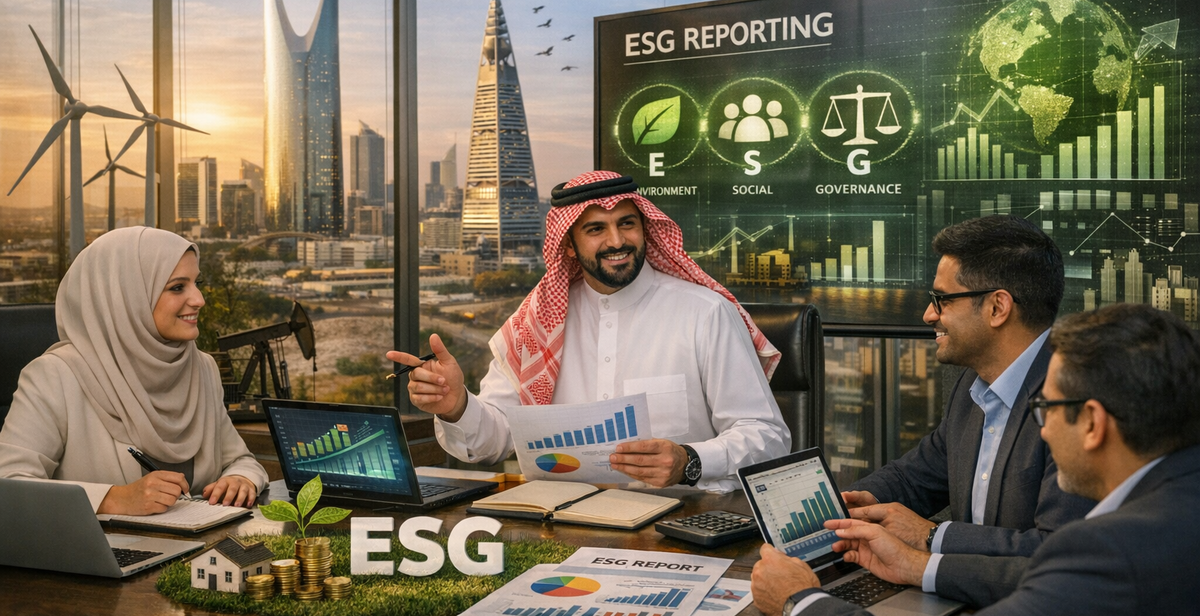
Introduction: Why ESG Reporting Is Becoming Essential in Saudi Arabia
In recent years, businesses across the world have started paying far greater attention to sustainability, transparency, and responsible governance. Saudi Arabia is no exception. As the Kingdom accelerates its economic transformation, ESG reporting in Saudi Arabia is becoming an increasingly important practice for organisations that want to attract investment, build trust, and demonstrate responsible business behaviour.
Driven by national initiatives such as Saudi Vision 2030, companies are now expected to consider not only financial performance but also environmental impact, social responsibility, and corporate governance practices.
Global investors, regulators, and stakeholders are increasingly asking questions such as:
-
How sustainable are company operations?
-
Are businesses managing environmental risks responsibly?
-
Do organisations follow strong governance and ethical practices?
To answer these questions, companies publish ESG reports that provide structured insights into their sustainability performance.
According to sustainability guidance from the Global Reporting Initiative, ESG disclosure helps organisations communicate their environmental and governance performance transparently to investors and stakeholders.
For Saudi companies aiming to compete internationally, ESG reporting is no longer optional — it is becoming a strategic business requirement.
In this guide, we explore:
-
What ESG reporting means
-
Why ESG reporting in Saudi Arabia is growing rapidly
-
The key frameworks companies use
-
How organisations can begin their ESG reporting journey
What is ESG Reporting?

To understand the importance of ESG reporting in Saudi Arabia, it is helpful to first clarify what ESG actually means.
ESG stands for:
|
ESG Factor |
What It Measures |
Example |
|
Environmental |
Impact on the natural environment |
Carbon emissions, energy use |
|
Social |
Treatment of employees and communities |
Workplace diversity, labour standards |
|
Governance |
Corporate leadership and accountability |
Ethics, board transparency |
ESG reporting is the process through which companies measure, track, and disclose these factors.
Instead of focusing only on profit, ESG reports show how a company manages sustainability risks and long-term value creation.
Why ESG Reporting Matters
Companies that publish ESG reports can:
-
increase investor confidence
-
improve corporate reputation
-
strengthen risk management
-
demonstrate commitment to sustainability
In global markets, ESG disclosures have become a standard expectation from institutional investors and regulators.
For organisations operating in the Kingdom, adopting ESG reporting in Saudi Arabia helps align business practices with international sustainability standards.
Why ESG Reporting Is Important in Saudi Arabia

The growing emphasis on ESG reporting in Saudi Arabia is closely linked to the Kingdom’s economic transformation and sustainability ambitions.
Several key drivers are accelerating the adoption of ESG reporting across Saudi industries.
1. Vision 2030 Sustainability Goals
Saudi Arabia’s national development strategy emphasises environmental sustainability, responsible governance, and economic diversification.
Major projects such as:
-
NEOM
-
The Line
-
Red Sea Project
are being designed with sustainability principles at their core.
As these initiatives expand, companies involved in infrastructure, energy, and development must demonstrate environmental and social accountability through ESG disclosures.
2. Increasing Expectations from Global Investors
International investors now place significant emphasis on ESG performance when evaluating companies.
According to insights published by the World Economic Forum, responsible investment strategies have become a major global trend, with investors increasingly prioritising sustainability data.
For Saudi companies seeking international capital, ESG transparency helps:
-
improve credibility with investors
-
strengthen long-term risk management
-
enhance corporate transparency
This is why ESG reporting is rapidly becoming part of corporate strategy across many Saudi organisations.
3. Expanding ESG Disclosure in the Saudi Market
Companies listed on the Saudi Exchange (Tadawul) are gradually increasing ESG disclosures to align with global investment standards.
Many organisations are now publishing sustainability reports that highlight:
-
environmental performance
-
workforce initiatives
-
governance practices
This trend signals a growing recognition that sustainability reporting is essential for long-term competitiveness.
Key ESG Reporting Frameworks Companies Should Know
One of the most important aspects of ESG reporting in Saudi Arabia is understanding the frameworks used to structure sustainability disclosures.
These frameworks provide standardised methods for measuring and reporting ESG performance.
Below are some of the most widely used frameworks globally.
Global Reporting Initiative (GRI)
The Global Reporting Initiative framework is one of the most widely used sustainability reporting standards worldwide.
It helps organisations report on:
-
environmental impact
-
social responsibility
-
governance transparency
GRI standards are particularly useful for companies looking to communicate sustainability performance to a broad range of stakeholders.
Sustainability Accounting Standards Board (SASB)
The Sustainability Accounting Standards Board focuses on ESG factors that affect financial performance.
SASB standards are widely used by investors to evaluate corporate sustainability risks.
Task Force on Climate-Related Financial Disclosures (TCFD)
The Task Force on Climate-related Financial Disclosures provides guidance on reporting climate-related financial risks.
TCFD helps organisations disclose:
-
climate risks
-
energy transition strategies
-
carbon reduction plans
As climate transparency becomes increasingly important, more companies are adopting TCFD recommendations.
Quick Comparison: GRI vs SASB vs TCFD
|
Framework |
Main Focus |
Typical Users |
|
GRI |
Broad sustainability reporting |
Corporations |
|
SASB |
Financial ESG metrics |
Investors |
|
TCFD |
Climate risk disclosure |
Financial markets |
Understanding these frameworks is a crucial step for organisations implementing ESG reporting in Saudi Arabia.
Key ESG Metrics Companies Report

When organisations implement ESG reporting in Saudi Arabia, they must measure specific sustainability indicators. These metrics help investors and stakeholders evaluate a company's environmental, social, and governance performance.
Most ESG reports focus on three categories.
Environmental Metrics
Environmental indicators measure how business activities affect the planet.
Common metrics include:
-
Carbon emissions and greenhouse gases
-
Energy consumption
-
Renewable energy usage
-
Water management
-
Waste reduction
For industries such as construction, energy, and manufacturing, environmental reporting is especially important because these sectors have significant environmental impact.
Social Metrics
The social component of ESG reporting in Saudi Arabia focuses on how organisations treat employees, communities, and stakeholders.
Typical social indicators include:
-
workforce diversity and inclusion
-
employee health and safety
-
training and development programmes
-
community engagement
-
labour standards
Companies increasingly recognise that strong social responsibility improves employee engagement and public trust.
Governance Metrics
Governance measures how companies are managed and how decisions are made.
Important governance indicators include:
-
board independence
-
executive compensation transparency
-
anti-corruption policies
-
shareholder rights
-
regulatory compliance
Strong governance practices are essential for maintaining investor confidence and ethical leadership.
Quick Fact
Many global investors now evaluate companies using ESG scoring systems that combine environmental, social, and governance performance into a single rating.
ESG Reporting vs Sustainability Reporting
Many professionals often ask: Are ESG reporting and sustainability reporting the same thing?
Although the terms are related, there are some differences.
|
Feature |
ESG Reporting |
Sustainability Reporting |
|
Primary Audience |
Investors and financial markets |
Broader stakeholders |
|
Focus |
ESG metrics and risk management |
Corporate sustainability initiatives |
|
Purpose |
Investment transparency |
Corporate responsibility communication |
In practice, many companies combine both approaches when publishing sustainability reports.
For organisations implementing ESG reporting in Saudi Arabia, the goal is to create transparent, measurable, and investor-focused sustainability disclosures.
Challenges Companies Face in ESG Reporting
While ESG reporting offers many benefits, companies often encounter challenges when implementing it for the first time.
Common challenges include:
Limited ESG Expertise
Many organisations lack professionals who understand ESG frameworks, sustainability data analysis, and reporting standards.
Data Collection Difficulties
Collecting reliable ESG data across departments can be complex, particularly for large organisations.
Multiple Reporting Frameworks
With several frameworks such as GRI, SASB, and TCFD available, companies sometimes struggle to determine which standards to follow.
Integration with Business Strategy
Some organisations find it difficult to align ESG reporting with existing operational and financial reporting processes.
Despite these challenges, businesses that adopt ESG reporting in Saudi Arabia early often gain a competitive advantage in the market.
How Companies Can Implement ESG Reporting
Companies looking to begin ESG reporting in Saudi Arabia can follow a structured approach.
Step 1: Define ESG Strategy
Organisations should align ESG goals with overall business strategy and sustainability objectives.
This includes identifying priority areas such as:
-
carbon reduction
-
workforce development
-
governance transparency
Step 2: Identify Relevant ESG Metrics
Companies must select measurable indicators based on their industry and operational impact.
For example:
-
energy companies may focus on emissions
-
financial institutions may prioritise governance and transparency
Step 3: Collect and Analyse ESG Data
Data collection is a critical step in ESG reporting.
Companies typically gather information from:
-
operational systems
-
HR departments
-
environmental monitoring tools
-
governance records
Step 4: Use Recognised ESG Frameworks
To ensure credibility, organisations structure their reports using recognised standards such as those developed by the Global Reporting Initiative.
Using established frameworks ensures that ESG disclosures are consistent, comparable, and credible.
Step 5: Publish ESG Reports
Finally, companies publish ESG reports to communicate sustainability performance to investors, regulators, and the public.
These reports may be published annually alongside financial statements.
Why ESG Skills Are Increasingly Valuable for Professionals
As organisations expand ESG reporting in Saudi Arabia, demand for professionals with ESG knowledge is rising across industries.
Key ESG-related roles include:
-
ESG analysts
-
sustainability managers
-
ESG reporting specialists
-
ESG consultants
-
sustainable finance professionals
These roles require expertise in sustainability frameworks, governance practices, and ESG performance measurement.
Professionals interested in developing practical knowledge in sustainability reporting and ESG frameworks can benefit from completing an ESG Certification, which provides structured training on ESG reporting standards, governance principles, and sustainability strategy.
Such programmes help professionals understand how organisations implement ESG reporting systems and sustainability disclosures in real-world business environments.
The Future of ESG Reporting in Saudi Arabia
Looking ahead, the importance of ESG reporting in Saudi Arabia will continue to grow.
Several trends support this development:
-
increasing global sustainability regulations
-
stronger investor focus on ESG transparency
-
expansion of sustainable finance initiatives
-
corporate commitment to responsible governance
Saudi Arabia’s economic transformation under Saudi Vision 2030 is also accelerating sustainability adoption across industries.
As businesses align with international sustainability expectations, ESG reporting will become a standard component of corporate strategy.
Frequently Asked Questions
What is ESG reporting?
ESG reporting is the process by which companies disclose information about their environmental, social, and governance performance. It helps investors and stakeholders evaluate how responsibly an organisation operates.
Why is ESG reporting important in Saudi Arabia?
ESG reporting in Saudi Arabia is becoming increasingly important because of sustainability initiatives linked to Vision 2030, growing investor expectations, and global ESG transparency standards.
Which ESG frameworks are commonly used?
Common ESG reporting frameworks include:
-
Global Reporting Initiative (GRI)
-
Sustainability Accounting Standards Board (SASB)
-
Task Force on Climate-Related Financial Disclosures (TCFD)
How can companies start ESG reporting?
Companies can start ESG reporting by:
-
defining sustainability goals
-
selecting ESG metrics
-
collecting ESG data
-
applying recognised reporting frameworks
-
publishing sustainability reports
Conclusion
The growing focus on ESG reporting in Saudi Arabia reflects a broader shift toward responsible and sustainable business practices across the Kingdom. As organisations align with global sustainability standards and the goals of Saudi Vision 2030, ESG reporting has become an essential tool for improving transparency, building investor confidence, and managing long-term risks.
For Saudi companies, effective ESG reporting is no longer just about compliance. It helps organisations demonstrate environmental responsibility, strengthen social impact, and maintain strong governance standards. Businesses that adopt clear ESG reporting frameworks can gain a competitive advantage by attracting investors, improving corporate reputation, and supporting sustainable economic growth.
At the same time, the expansion of ESG reporting in Saudi Arabia is creating new opportunities for professionals who understand sustainability metrics, governance frameworks, and ESG disclosure standards.
As demand for ESG expertise continues to grow, professionals who develop specialised knowledge will play a key role in helping organisations implement effective ESG strategies.
For individuals looking to build practical skills in sustainability reporting and governance practices, pursuing an ESG Certification can provide valuable knowledge and help prepare professionals for emerging ESG roles in Saudi Arabia.
As the Kingdom continues its journey toward a more sustainable and transparent economy, ESG reporting will remain a crucial part of shaping the future of responsible business in Saudi Arabia.