Iran — a single word dominating international headlines every single day since early 2026, rarely absent from any conversation touching energy markets, global finance, or regional geopolitics. Yet what often gets lost behind the warfare and sanctions headlines is the question that keeps compliance professionals, financial institutions, and Gulf businesses up at night: How does this crisis reshape the compliance landscape? And what has fundamentally changed in the risk environment?
In this article, we take an objective, detailed look at the situation: the roots of the crisis, the implications of the Strait of Hormuz closure, the layered sanctions architecture, and the direct consequences for businesses operating in the Gulf — particularly in Saudi Arabia.
Part One: Iran in 2026 — Where Things Stand
The region is living through a historically significant and dangerous inflection point. On February 28, 2026, the United States and Israel launched a coordinated military operation known as "Operation Epic Fury," targeting military infrastructure, ballistic missile programs, and nuclear sites on Iranian soil. The strikes killed Supreme Leader Ali Khamenei — an event without modern precedent — prompting Iran to launch extensive retaliatory operations against Israel and American military bases throughout the Gulf.
While official narratives tend to focus on the military dimension, what many overlook is that Iran identified the closure of the Strait of Hormuz as a weapon of economic warfare no less lethal than its missiles.
Part Two: The Strait of Hormuz — The Artery the World Breathes Through

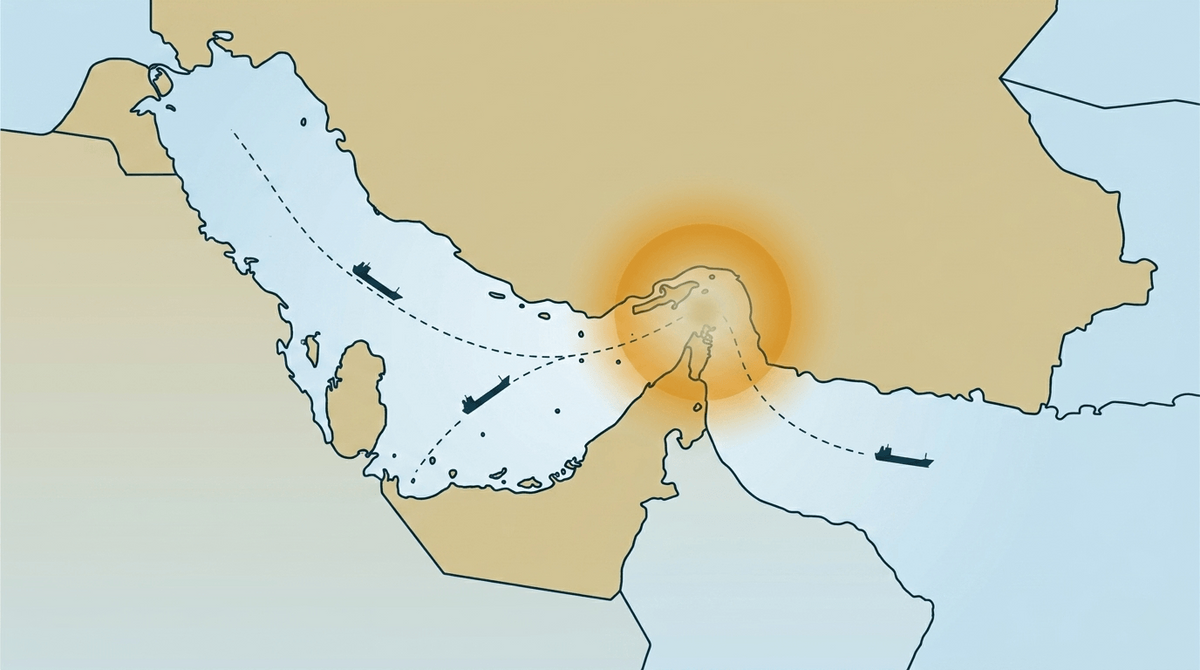
The Strait of Hormuz, flanked by Iran to the north and Oman to the south, is a maritime passage no wider than 33 kilometers at its narrowest point, yet it represents one of the most strategically vital waterways in human history. Before the current crisis, the strait carried approximately 20% of the world's total seaborne oil trade and 20% of liquefied natural gas (LNG), along with enormous quantities of petrochemicals, sulfur, and other strategic commodities.
On March 4, 2026, Tehran officially declared the strait closed to international navigation, and subsequent attacks using drones and sea mines struck multiple oil tankers and cargo ships that attempted to transit. Shipping traffic quickly fell to approximately 5% of normal levels (which had been around 3,000 vessels per month prior to the conflict).
The economic significance of this closure cannot be measured by the oil barrel price alone — it directly impacts:
- Saudi Arabian exports, which represent approximately 5.5 million barrels per day transiting the strait
- Kuwaiti, Emirati, Iraqi, and Qatari exports
- Sulfur and sulfuric acid prices affecting African mining operations
- Asian LNG energy contracts and pricing
Part Three: The Conflict's Arc — From Airstrikes to Mutual Naval Blockade
The Strait closure was not an isolated act. On April 13, 2026, the United States announced a counter-blockade targeting Iranian ports, while Iran's Islamic Revolutionary Guard Corps (IRGC) continued launching drone strikes on shipping vessels across an expanding area that included parts of Kuwaiti waters. An oil tanker explosion near Mubarak Al-Kabeer Port in Kuwait — over 800 kilometers from the strait — signaled a significant geographic escalation.
Amid this military escalation, marine insurance providers entered a state of deep uncertainty, with many suspending war-risk coverage for commercial vessels, while Brent crude surpassed $105 per barrel by early May 2026.
On the diplomatic front, Pakistan-mediated negotiations continue, the United Kingdom and France have hosted international conferences focused on reopening the strait, and 38 countries have signed a joint statement demanding safe passage and condemning attacks on commercial shipping. Meanwhile, Washington has sought to leverage Beijing's relationship with Tehran, though China's willingness to apply meaningful pressure remains unclear.
Part Four: International Sanctions on Iran — A Complex, Ever-Tightening Architecture

Understanding the current crisis requires a grasp of the layered, decades-long sanctions architecture that surrounds Iran.
1. U.S. Sanctions (OFAC)
The United States has imposed broad trade restrictions on Iran since the late 1980s and 1990s, progressively expanding them to cover oil and energy, insurance, shipping, financial services, and secondary sanctions that target third-party actors conducting business with Iran. In February 2025, President Trump issued a National Security Presidential Memorandum launching a "Maximum Pressure" campaign aimed at driving Iranian oil exports to zero, including significant modifications to sanctions waivers. In May 2026, OFAC issued a specific alert warning maritime and financial institutions of sanctions risks arising from paying Iranian "transit fees" for passage through the Strait of Hormuz.
2. UN Security Council Sanctions
On September 28, 2025, the UN Security Council formally reimposed a sweeping package of sanctions on Iran through the Snapback Mechanism, after determining that Tehran had engaged in significant non-performance of its nuclear obligations. The reimposed measures revived restrictions on nuclear-related equipment, arms transfers, petroleum and petrochemicals, gold and precious metals, and financial dealings with designated Iranian entities.
3. EU and UK Sanctions
The European Union and the United Kingdom announced parallel sanctions packages on September 28–29, 2025, aligning with the UN resolution and expanding restrictions on entities and individuals linked to the Iranian economy.
Iran's Shadow Fleet: A Critical Compliance Challenge
International reports document Iran's expanding reliance on what has become known as the "shadow fleet" — oil tankers that disable their Automatic Identification System (AIS) transponders and conduct ship-to-ship transfers in grey zones near Malaysia and the Gulf of Oman to obscure the origin of Iranian oil and circumvent sanctions. Unintentional exposure to this fleet represents one of the most pressing compliance risks facing shipping companies, insurers, and banks financing maritime trade.
Part Five: Implications for the Gulf and Saudi Economy
Saudi Arabia is the country most exposed to the Strait's closure on the export side, with approximately 5.5 million barrels per day of oil transiting it. While the East-West Pipeline connecting the Kingdom to the Red Sea port of Yanbu provides an alternative route, its capacity is insufficient to absorb the full volumes normally exported through the strait.
Beyond the export channel, several critical regional infrastructure sites have come under attack, with the UAE reporting repeated Iranian missile and drone strikes on its territory, including the Fujairah area, affecting the confidence of shipping companies and insurers across the entire region.
In this context, businesses and financial institutions operating in the region face an exceptional set of challenges:
- Sharp increase in marine insurance premiums
- Difficulty completing shipping deals and vessel financing
- Regulatory ambiguity around dealing with entities connected to Iranian shipping
- Heightened risk of inadvertent sanctions violations
- Urgent need to revise Due Diligence policies at banks and trade finance firms
Part Six: What This Means for Compliance Officers and Financial Institutions
No institution operating in Saudi Arabia or the Gulf states, regardless of sector, can afford to ignore the rapidly evolving developments around Iran and their impact on the compliance framework.
1. Money Laundering and Terrorism Financing Risks
Documented reports show that Iran channels financing to militias and armed groups in the region through complex networks of intermediaries and shell companies, raising the alert level of Anti-Money Laundering units at banks and financial institutions. Saudi Arabia's AML framework — administered by the Saudi Central Bank (SAMA) and the Financial Intelligence Unit — requires institutions to elevate their monitoring of transactions related to the broader region.
2. International Sanctions Compliance Requirements
Compliance with OFAC and UN sanctions demands rigorous screening of transaction counterparties (Know Your Customer / KYC), verification against sanctions designation lists, and reassessment of business relationships with any party potentially linked — directly or indirectly — to the Iranian economy. Critically, OFAC's May 2026 alert specifically warned maritime and financial institutions of sanctions risks arising from any payment of Iranian demands related to Strait passage.
3. Shadow Fleet and Sanctions Evasion Risks
Iranian shadow fleet tankers represent a growing challenge. U.S. authorities and multiple governments have issued detailed guidance to help shipping companies, banks, and port operators identify the warning signs of dealings with these vessels — including disabled AIS transmissions, inconsistent shipping documentation, and opaque ownership structures.
4. Disclosure and Reporting Obligations
Compliance responsibility does not end at identity verification. It extends to monitoring suspicious transactions and filing Suspicious Transaction Reports (STRs) with Saudi Arabia's Financial Intelligence Unit, as well as ensuring that screening policies are documented and regularly updated.
Part Seven: Building Your Team's Capacity to Navigate Compliance Risks

In a landscape this volatile, investing in your team's compliance capabilities shifts from a best practice to a strategic imperative. Equipping compliance officers, bankers, lawyers, and risk managers with the knowledge to navigate the sanctions architecture, apply AML/KYC standards correctly, and detect emerging risks is precisely what protects an institution from significant financial penalties and legal exposure.
Saudi Compliance Institute offers professional online courses specifically designed for the Saudi work environment, aimed at building a genuine compliance culture at the individual and organizational level. In the context of the current risk environment, two areas are particularly relevant:
- Compliance Risk Management Course — Covers the fundamentals of regulatory risk assessment and compliance policy development, suitable for compliance officers, internal auditors, and professionals across the financial sector and beyond.
For institutions engaged in international shipping or trade finance, AML and Due Diligence courses carry exceptional value in building team readiness for the current risk environment. Browse all available courses here.
Part Eight: Looking Ahead — Is There a Path to Resolution?
Current indicators suggest the crisis remains in a phase of deep instability. President Trump has rejected Iran's counterproposal, calling it "totally unacceptable," while Tehran has vowed it will "never bow" — suggesting continued pressure on maritime shipping in the near term. Meanwhile, China–Iran diplomatic engagement continues in an attempt to ease tensions, and the transit of a Qatari LNG tanker through the strait in early May 2026 offered a limited signal of possible partial easing.
Nevertheless, prudent institutions do not plan based on temporary optimism — they design their institutional frameworks to accommodate multiple risk scenarios.
Conclusion: Compliance Is Not a Luxury — It Is the Shield in Times of Crisis
From a closed Strait of Hormuz to escalating international sanctions on Iran, from drone strikes on Gulf oil tankers to the tightening global sanctions architecture — the message could not be clearer: the environment in which Gulf businesses operate today is more complex and more volatile than it was even a few months ago. In such environments, the gap between institutions with a robust compliance framework and those without one widens rapidly.
Effective institutional compliance — built on a deep understanding of sanctions regimes, AML requirements, and counterparty risk management — is what allows an organization to weather the storm and protect its reputation, assets, and future.
Published by: Saudi Compliance Institute | All Rights Reserved © 2026
Sources: U.S. Congressional Research Service, Office of Foreign Assets Control (OFAC), UK House of Commons Library, Columbia University Energy Policy, Al Jazeera English, CNBC.